
Disposable Bed Pads for Adults: Sizes, Uses and How to Choose

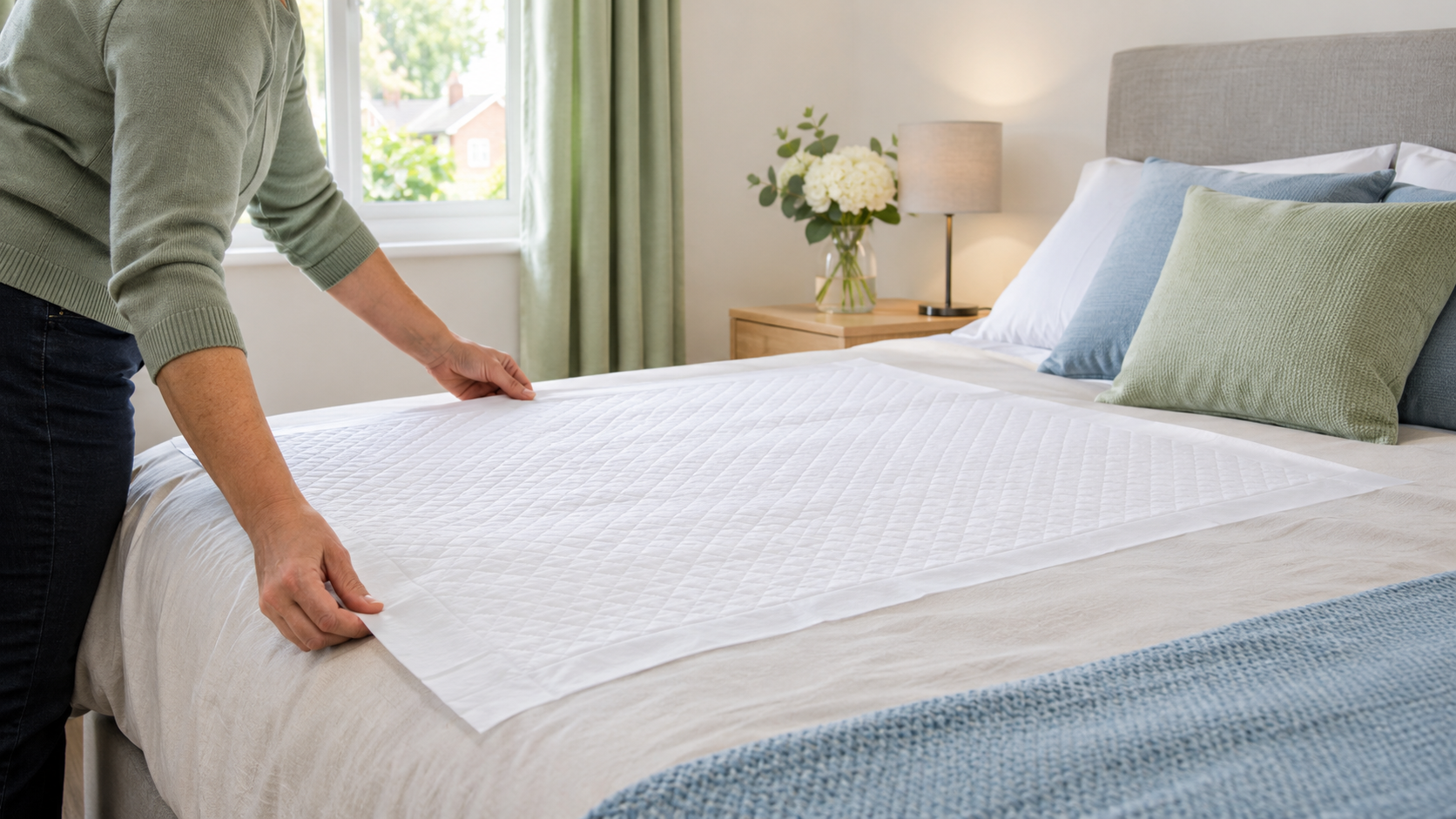
Disposable bed pads can make everyday incontinence care simpler by
helping protect mattresses, bedding, chairs and other suitable surfaces
from leaks. They are quick to replace, easy to store and useful at home,
during personal care or while travelling.
The best option is not automatically the largest pad or the biggest
pack. A suitable disposable bed pad should cover the area most likely to
be affected, offer an appropriate level of absorbency, remain flat
during use and fit comfortably into the person’s changing routine.
This guide explains how to compare disposable
bed pads for adults by size, coverage, construction and practical
use. For a broader comparison of all bed pad types, start with the main
bed
pad buying guide.
Quick answer: Measure the area that needs
protection, identify when and how leakage normally occurs, and check
absorbency separately from dimensions. A larger pad protects more
surface area but is not automatically more absorbent. If leakage is
regular or heavier, use the bed pad as backup within a wider continence
routine rather than relying on surface protection alone.
What are disposable bed pads?
A disposable bed pad is a single-use absorbent sheet placed over a
bed, chair or another suitable surface. It may also be described as a
disposable underpad, inco pad, incontinence sheet or mattress protection
pad.
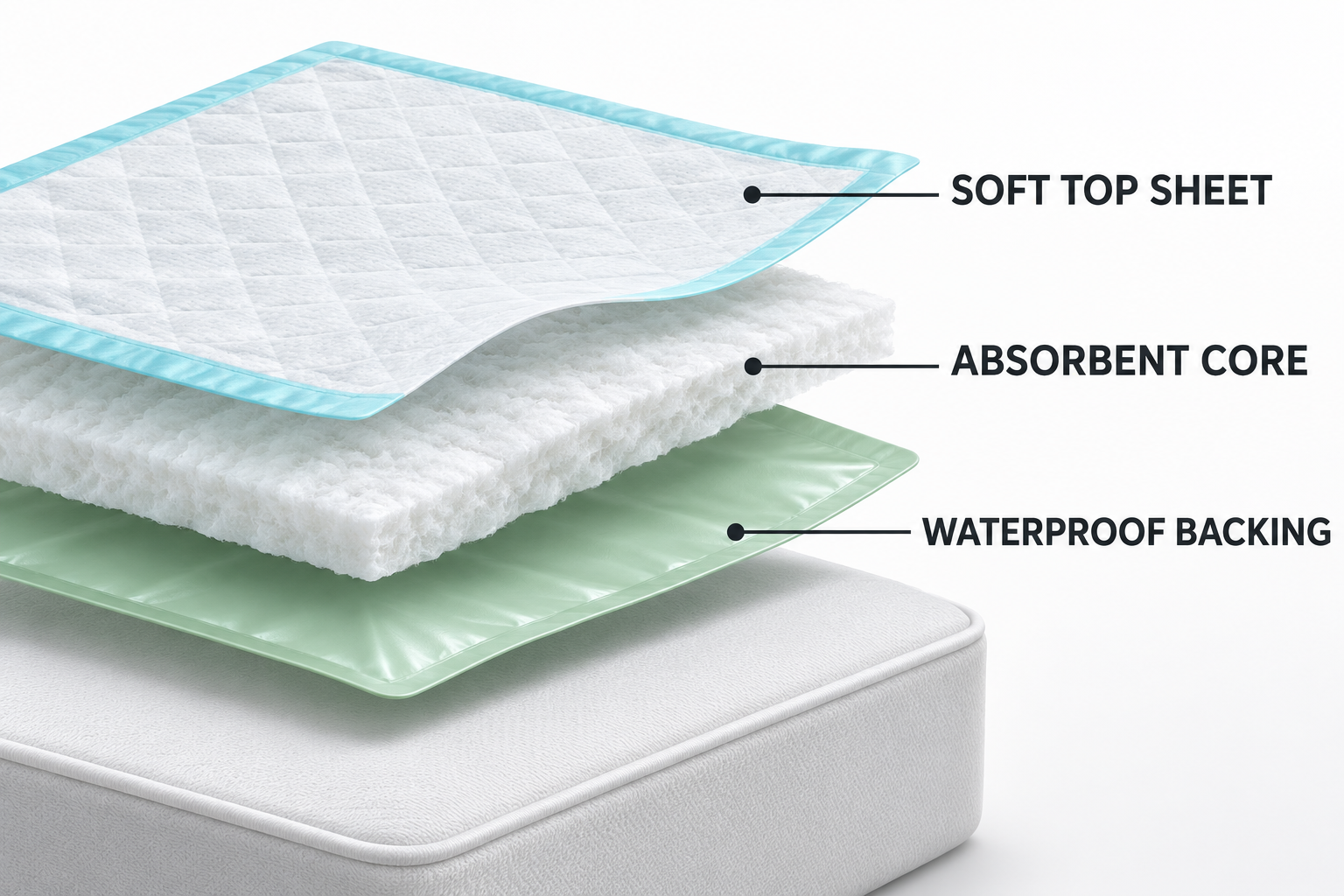
Most disposable underpads contain three functional parts:
- a soft, non-woven top sheet that allows liquid to move into the
pad; - an absorbent core that captures and distributes moisture; and
- a waterproof backing that helps stop liquid reaching the surface
below.
Some products include extra layers or features intended to improve
distribution or stability. Construction varies between brands, so
dimensions alone do not tell you how a pad will perform.
The Continence
Product Advisor explains that disposable underpads are commonly used
to protect beds and chairs against leaks from other continence products
or during care tasks. The NHS
also lists bed and chair protection among products that can help manage
the practical effects of incontinence.
Important: A disposable bed pad protects a surface;
it does not diagnose or treat bladder or bowel symptoms. New, worsening
or unexplained symptoms should be discussed with a GP or continence
professional.
When are disposable bed
pads useful?
Disposable bed pads can be useful in several situations:
- as backup beneath a suitable body-worn incontinence pad or
pull-up; - for light or occasional leakage during sleep;
- during product changes, personal care or use of a bedpan;
- on a suitable chair for temporary surface protection;
- during travel, respite stays or overnight visits; and
- when quick replacement is more practical than immediate
laundry.
They can help limit how much bedding needs changing after a leak, but
they should not automatically replace a body-worn product for regular or
heavier incontinence. If leaks repeatedly reach the bed despite correct
placement, review the fit, absorbency and condition of the whole product
combination.
Six
things to compare before buying disposable bed pads
1. Leakage pattern and
intended role
Start with how the pad will actually be used.
Ask:
- Is leakage occasional, regular or mainly overnight?
- Is the bed pad backup for a body-worn product?
- Is it needed for a bed, chair, care task or travel?
- Does the person move frequently while sleeping?
- Can the person change the pad independently, or will a carer
help?
For regular or heavier leakage, disposable underpads are generally
more suitable as surface protection alongside another appropriate
continence product. If a current routine is not working, stacking extra
pads is not a reliable solution. The waterproof backing of the top pad
can stop liquid passing to the pad underneath, while additional folds
may cause movement or discomfort.
2. Coverage size
Pad dimensions describe coverage, not absorbency. Measure the area
most likely to be affected and consider the person’s sleeping position
and movement.
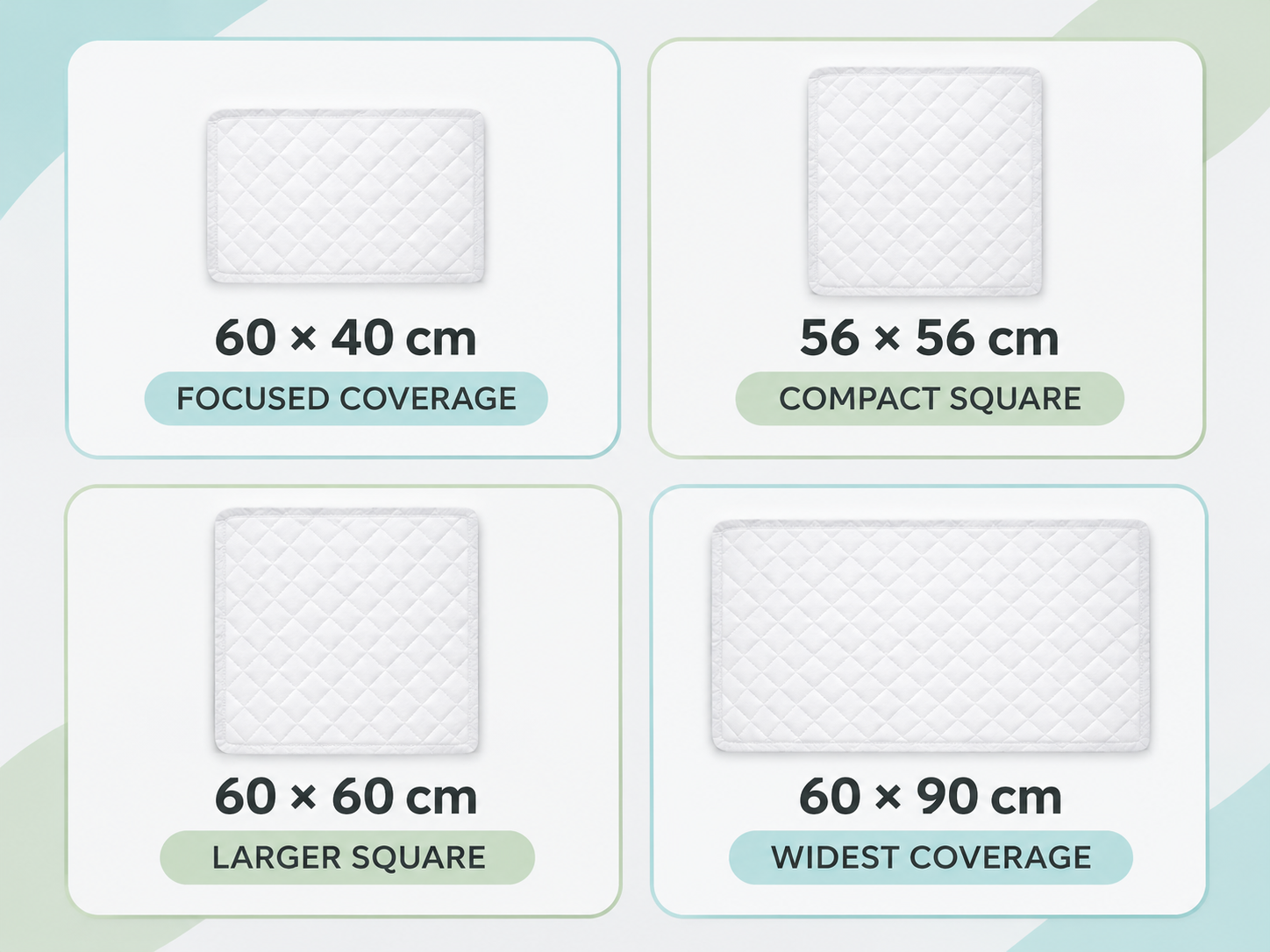
AvaDry disposable bed pads are available in four sizes:
| AvaDry size | Coverage profile | When to consider it | Product |
|---|---|---|---|
| 60 × 40 cm | Compact rectangular coverage | Focused protection, personal care or a smaller target area | View 60 × 40 cm bed pads |
| 56 × 56 cm | Compact square coverage | A balanced compact area where equal width and length are useful | View 56 × 56 cm bed pads |
| 60 × 60 cm | Larger square coverage | Broader protection for someone who changes position | View 60 × 60 cm bed pads |
| 60 × 90 cm | Widest AvaDry coverage | More surface coverage for active or restless sleepers | View 60 × 90 cm bed pads |
Use enough coverage for the target area without leaving unnecessary
material that may bunch or fold. If you are unsure, trial a manageable
pack before ordering a larger quantity.
3. Absorbency—not size
or thickness alone
A larger pad is not automatically more absorbent. Absorbency depends
on the materials, the quantity and distribution of the absorbent core,
and how quickly liquid moves away from the surface.
When comparing products:
- look for a stated absorbency or intended protection level;
- consider whether leakage is gradual or occurs in a larger
amount; - check whether moisture is distributed across the core rather than
pooling; - review whether the top surface remains comfortable after absorption;
and - compare real use with the product description instead of relying on
appearance alone.
If a pad leaks, check its position before assuming that absorbency is
too low. A pad that has shifted, folded or missed the likely leakage
area cannot protect the surface effectively.
4. Waterproof backing and
stability
An absorbent core needs a waterproof backing to help protect the
mattress or chair underneath. Place the backing against the surface and
keep the soft absorbent side facing upwards.
Disposable pads are lightweight and can move when a person turns,
transfers or is repositioned. To improve stability:
- unfold the pad completely;
- centre it beneath the area most likely to need protection;
- smooth out every crease;
- check that the edges are not folded beneath the body; and
- recheck the position after movement or care.
A wider pad provides a larger protected area, but only when it stays
in the correct position. Do not place a disposable pad over electrical
cables, damaged heated bedding or close to naked flames and strong heat
sources.
5. Surface comfort and
changing routine
Comfort matters, particularly when skin may come into contact with
the top surface. Look for a soft top sheet and keep the pad flat. Check
regularly and replace it when wet, soiled, damaged or as directed by the
manufacturer.
Prolonged exposure to moisture, friction or folds may contribute to
skin discomfort. If skin becomes persistently red, sore, broken or damp,
seek advice from a GP, district nurse or continence professional.
For practical timing guidance, read How
Often Should You Change Bed Pads?. You can also review how
to maintain proper hygiene with incontinence bed pads for storage,
changing and clean-up tips.
6. Pack quantity,
storage and routine cost
The lowest price per pad is not always the best first purchase.
Before buying a large quantity, confirm that the chosen size, coverage
and changing routine work for the person.
Estimate likely use by considering:
- how many changes are normally needed each day or night;
- whether the pad is for occasional or regular use;
- how often deliveries can be received;
- how much dry storage space is available; and
- whether extra stock is needed for travel or unexpected leaks.
Store unopened packs in a clean, dry place away from strong heat and
moisture. Keep enough spare pads for the normal routine without buying
so many that unsuitable stock is left unused.
How to choose an
AvaDry size by situation
The following starting points can help narrow the options:
| Situation | Priority | Practical starting point |
|---|---|---|
| Focused care task or a smaller target area | Easy placement and compact coverage | Compare 60 × 40 cm and 56 × 56 cm |
| Adult who sleeps mainly in one position | Coverage under the likely leakage area | Start with a compact or medium size and review after use |
| Adult who turns frequently | Wider coverage and regular position checks | Compare 60 × 60 cm and 60 × 90 cm |
| Backup beneath a body-worn product | Position under the most likely leak path | Match coverage to sleeping position rather than the whole mattress |
| Travel or respite care | Packability and simple disposal | Select a proven size and carry sufficient replacements |
| Reduced mobility or assisted transfers | Flat placement and comfort | Avoid folds and recheck after repositioning |
This is a practical selection framework, not a clinical assessment.
For complex needs, recurring leaks, bowel leakage, skin damage or
difficulty using current products, ask a healthcare or continence
professional for individual advice.
For older-adult care considerations, including dignity, mobility and
skin comfort, see How to Choose
Bed Pads for Elderly Adults.
How to use a
disposable bed pad correctly
- Prepare a clean, dry bed, chair or other suitable surface.
- Unfold the pad fully without tearing or stretching it.
- Place the soft absorbent side facing upwards.
- Put the waterproof backing against the mattress, sheet or
chair. - Centre the pad beneath the area most likely to need protection.
- Smooth it flat and remove folds or raised edges.
- Recheck the position after the person moves or receives care.
- Replace the pad when wet, soiled or damaged.
- Fold or roll the used pad inward and place it in a suitable waste
bag. - Follow local household or clinical waste guidance, and never flush
it down the toilet.
Explain the routine to the person, protect their privacy and involve
them in product choices wherever possible. Surface protection should
support comfort and dignity rather than make care feel unnecessarily
clinical.
Disposable or washable bed
pads?
Disposable and washable bed pads both protect surfaces, but they suit
different routines.
| Factor | Disposable bed pads | Washable bed pads |
|---|---|---|
| Use | Single use | Wash, dry and reuse |
| Convenience | Quick replacement and no pad laundry | Requires washing, drying and spare stock |
| Travel | Easy to pack and dispose of appropriately | Needs access to laundry facilities |
| Ongoing cost | Requires repeat purchases | Initial cost may be spread over repeated use |
| Waste and resources | Creates single-use waste | Reuse reduces single-use waste but uses water and energy |
| Feel | Depends on top-sheet construction | Often has a fabric-like surface |
Some households use washable protection for a regular home routine
and keep disposable pads for travel, temporary care or quicker clean-up.
The right balance depends on laundry access, storage, budget, comfort
and personal preference.
Read the detailed comparison: Disposable
vs Reusable Bed Pads: Which One Is Better?.
Common mistakes to avoid
- Choosing by size alone: Dimensions describe
coverage, not absorbency. - Buying the largest pack before testing: Confirm
that the size and routine work first. - Stacking waterproof-backed pads: The upper backing
can prevent the lower pad from absorbing. - Using a bed pad as the only protection for regular heavier
leakage: Surface pads are often better as backup within a wider
continence plan. - Ignoring movement: A shifted pad cannot protect the
intended area. - Leaving a wet or soiled pad in place: Regular
checks support comfort and skin care. - Reusing a disposable pad: Disposable bed pads are
designed for single use. - Flushing used pads: Place them in suitable waste
and follow local guidance.
Frequently asked questions
What is
the best size disposable bed pad for an adult?
The best size depends on the area needing protection and how much the
person moves. Compact 60 × 40 cm or 56 × 56 cm pads provide focused
coverage, while 60 × 60 cm and 60 × 90 cm options cover a wider area.
Check absorbency separately from dimensions.
Can disposable bed
pads be used every night?
They can be used regularly when they suit the person’s care plan and
are checked and changed appropriately. Recurring leaks, changing
symptoms or skin problems should prompt a review of the wider continence
routine with a healthcare professional.
Which side of a
disposable bed pad faces up?
The soft absorbent side faces the user, while the waterproof backing
faces the mattress, sheet or chair. Check the product instructions if
the two sides are not clear.
Can
disposable bed pads replace adult incontinence pants or pads?
Not always. A bed pad protects the surface beneath the person. For
regular or heavier leakage, it is commonly used as backup alongside a
suitable body-worn continence product.
Can a
disposable bed pad be reused if it looks dry?
Disposable bed pads are intended for single use. Replace the pad
after it becomes wet, soiled or damaged and follow the product
instructions and care routine.
Can disposable
underpads be used on chairs?
Many underpads can protect suitable chairs as well as beds. Choose
appropriate coverage, keep the pad flat and check that it does not shift
or create uncomfortable folds.
How many disposable
bed pads should I buy?
Start with a manageable quantity if you have not confirmed the
correct size. Once the pad works for the person’s normal routine,
estimate daily or weekly use and keep a reasonable spare supply for
unexpected leaks, travel or delivery delays.
Compare disposable bed
pads for adults
The right disposable bed pad should match the person’s leakage
pattern, protect the necessary area and remain comfortable and stable
during use. Compare coverage and absorbency separately, test the size
before bulk buying and review the wider continence routine if leaks
continue.
Shop
AvaDry disposable incontinence bed pads in four coverage sizes, or
return to the main bed
pad buying guide for a complete comparison of size, absorbency,
backing and reusable options.