
How to Choose Bed Pads for Elderly Adults: A Practical UK Guide


Choosing bed pads for an elderly family member is not simply a matter
of buying the largest pack or the thickest-looking product. The right
choice depends on how much of the bed needs protecting, when leakage
usually happens, how much the person moves, whether they can change the
pad independently, and how the product fits into their wider care
routine.
Older people are not all the same. One person may need occasional
backup protection at night, while another may need help with regular
changes, repositioning or transferring between a bed and chair. Comfort,
dignity and the person’s own preferences should remain central to the
decision.
This guide explains how to compare bed
pads for incontinence for an older adult and how to choose suitable
coverage without confusing size with absorbency.
Quick answer: Start by identifying the usual leakage
pattern, measuring the area that needs protection and checking how much
the person moves in bed. Then compare pad stability, surface comfort,
waterproof backing and the practical changing routine. A bed pad
protects the mattress or chair; it should not automatically replace a
suitable body-worn continence product for regular or heavier
leakage.
Why an older adult may
need a bed pad
An absorbent bed pad sits on top of a bed, chair or other suitable
surface to help protect it from leaks. It may be used:
- as backup protection beneath a person wearing a body-worn continence
pad; - during personal care or product changes;
- for light or occasional overnight leakage;
- to reduce the amount of bedding affected by an accident; or
- for reassurance while travelling or staying away from home.
The NHS
guidance on incontinence products includes absorbent bedding among
the products that may help manage overnight leaks. It also advises that
access to NHS continence products can depend on local eligibility and a
professional assessment.
Incontinence should not be treated as an unavoidable part of ageing.
New, worsening or unexplained bladder or bowel symptoms should be
discussed with a GP, community nurse or local continence service. A bed
pad helps manage the practical effects of leakage; it does not identify
or treat the underlying cause.
Seven factors to compare
before buying
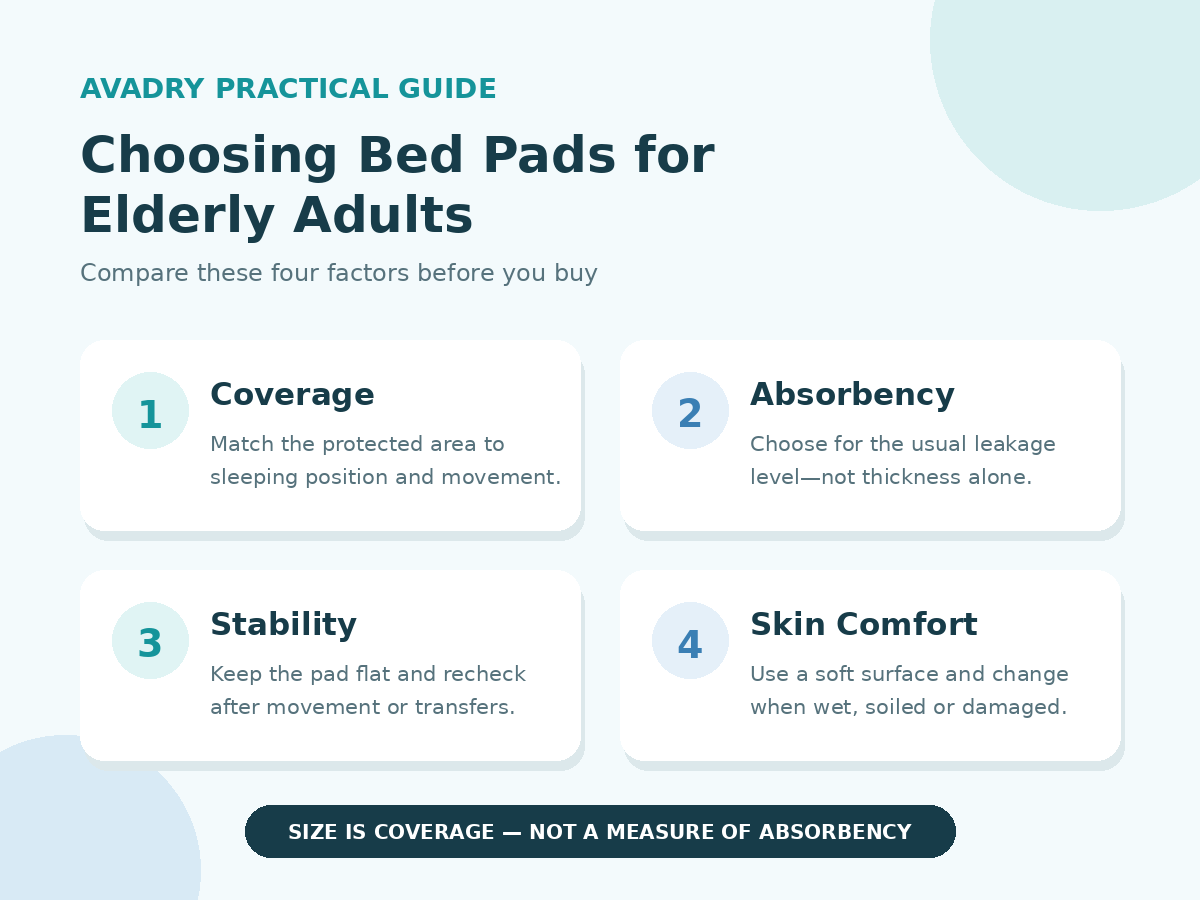
1. The level and timing of
leakage
Begin with the person’s usual pattern rather than a product name.
Ask:
- Is leakage light and occasional, or does it happen most nights?
- Does it occur mainly while asleep, during transfers or during
personal care? - Is a body-worn pad already being used?
- Are leaks caused by the current product reaching capacity, moving
out of position or fitting poorly?
The independent Continence
Product Advisor explains that disposable and washable underpads are
commonly used to protect beds and chairs against leakage from other
products. For regular or heavier leakage, surface protection is
generally more effective as part of a wider continence plan than as the
only protection.
Do not stack two waterproof-backed bed pads to try to double
absorbency. The waterproof layer can prevent liquid passing into the
lower pad, while extra folds may reduce comfort and stability.
2. Coverage and sleeping
position
Bed pad dimensions describe the surface area covered. They do not
tell you how much liquid the pad can absorb.
Measure the part of the bed most likely to need protection and
consider the person’s usual position. Someone who sleeps in one position
may need focused coverage, while a person who turns frequently may
benefit from a wider protected area.
| AvaDry size | Coverage profile | When to consider it |
|---|---|---|
| 60 × 40 cm | Compact rectangular area | Focused protection or care tasks on a smaller target area |
| 56 × 56 cm | Compact square area | Balanced coverage where equal width and length are useful |
| 60 × 60 cm | Larger square area | A broader area for someone who changes position |
| 60 × 90 cm | Widest AvaDry coverage | More surface protection for active or restless sleepers |
Compare the available AvaDry
bed pad sizes and trial a manageable quantity before committing to a
large pack.
3. Absorbency—not thickness
alone
A thicker-looking pad is not necessarily more absorbent. Performance
depends on the absorbent core, how quickly moisture is drawn away from
the surface, and how evenly liquid is distributed.
When comparing disposable bed pads for an elderly adult:
- look for a stated absorbency or intended protection level;
- consider whether leakage happens gradually or in a larger
amount; - check whether the surface is designed to remain comfortable after
absorption; and - review placement and movement if a current product leaks.
If protection repeatedly fails despite correct positioning, the wider
continence product combination may need reassessment. More surface
coverage alone may not solve a fit or absorbency problem.
4. Stability for movement
and transfers
A lightweight disposable pad can fold or shift if the person turns
frequently, slides down the bed or needs help transferring between the
bed and a chair.
Place the pad flat over the target area and smooth out every crease.
Recheck its position after repositioning or a transfer. A wider pad may
provide a larger margin of protection, but only if it remains in the
correct place.
For someone with reduced mobility, also check that the pad does not
create a raised edge or bunch beneath the body. If the person is at risk
of pressure damage, follow their care plan and ask a healthcare
professional for advice rather than relying on a product change
alone.
5. Skin comfort and
changing frequency
Older skin may be fragile, especially when it is exposed to moisture,
friction or pressure. Check the bed pad regularly and replace it when
wet, soiled, damaged or as directed by the manufacturer.
Look for:
- a soft top layer;
- fast transfer of liquid into the absorbent core;
- a flat surface without folds;
- a changing routine that avoids prolonged dampness; and
- compatibility with any skin-care plan provided by a clinician.
If skin becomes persistently red, sore, broken or damp, seek advice
from a GP, district nurse or continence professional. Do not put talcum
powder or unapproved creams directly onto an absorbent product because
they may affect performance.
For routine guidance, read How
Often Should You Change Bed Pads?.
6. Independence,
dignity and personal preference
The most protective product is not automatically the best choice if
the person finds it uncomfortable, undignified or difficult to
manage.
Where possible, involve the older adult in decisions about:
- disposable or washable protection;
- the feel and size of the pad;
- who helps with changes;
- how spare products are stored; and
- how privacy is maintained during care.
A person who changes their own bed pad may prefer a lighter,
easier-to-handle size. A family or professional carer may prioritise
quick access, clear storage and a reliable supply of replacements. The
routine should support independence wherever it is safe and
practical.
7. Disposable or washable use
Disposable and washable bed pads can both protect a surface, but
their routines are different.
| Factor | Disposable bed pads | Washable bed pads |
|---|---|---|
| Changing | Replace and dispose of after use | Remove, wash, dry and reuse |
| Laundry | Reduces washing of the pad itself | Requires laundry time and spare pads |
| Travel | Convenient for trips and temporary stays | Requires washing and drying access |
| Storage | Needs space for replacement packs | Needs space for clean and used laundry rotation |
| Long-term cost | Ongoing replacement cost | Higher initial cost may be spread over repeated use |
Some households combine both: washable protection for a regular home
routine and disposable bed pads for travel, respite care or quicker
clean-up. Read the full comparison in Disposable
vs Reusable Bed Pads: Which One Is Better?.
Choosing by care situation
| Situation | Priority to check | Practical starting point |
|---|---|---|
| Occasional light overnight leak | Focused coverage and comfort | Trial a compact size and review placement after use |
| Restless or active sleeper | Wider coverage and stability | Compare 60 × 60 cm and 60 × 90 cm options |
| Backup for a body-worn pad | Position beneath the likely leak area | Match coverage to sleeping position, not the whole mattress by default |
| Personal care or product changes | Easy replacement and waterproof backing | Use a clean disposable pad on a suitable flat surface |
| Travel or respite stay | Packability and simple disposal | Carry enough replacements plus waste bags |
| Reduced mobility | Flat placement and regular checks | Avoid folds and recheck after repositioning or transfers |
This table is a starting framework, not a clinical assessment. If the
person has complex needs, recurrent leaks, skin damage, bowel leakage or
difficulty using current products, ask their healthcare team or
continence service for individual advice.
How to place a
disposable bed pad safely
- Wash and dry your hands and prepare a clean, dry surface.
- Unfold the bed pad fully without tearing or stretching it.
- Place the soft absorbent side facing upwards.
- Put the waterproof backing against the mattress, sheet or
chair. - Centre the pad beneath the area most likely to need protection.
- Smooth out folds and make sure the edges do not create
discomfort. - Recheck the position after the person moves or receives care.
- Replace the pad when wet, soiled or damaged, following the product
instructions.
Never flush a disposable bed pad. Fold or roll it inward, place it in
a suitable waste bag and follow local household or clinical waste
guidance.
Common mistakes carers
should avoid
- Buying by dimensions alone: Size describes
coverage, not absorbency. - Choosing the largest pack before testing: Trial the
size and routine first. - Stacking waterproof-backed pads: The lower pad may
not absorb liquid and folds can reduce comfort. - Ignoring movement: A pad cannot protect the
intended area after it has shifted away. - Leaving a wet or soiled pad in place: Regular
checks support comfort and skin care. - Removing the person from decisions: Product choice
should protect dignity as well as bedding. - Treating recurring leaks as only a product problem:
Fit, toileting, mobility and clinical needs may also require
review.
Frequently asked questions
What size bed
pad is best for an elderly person?
The best size depends on the area requiring protection and how much
the person moves. A 60 × 40 cm or 56 × 56 cm pad offers focused
coverage, while 60 × 60 cm and 60 × 90 cm options cover a larger area.
Compare absorbency separately from dimensions.
Are
disposable bed pads suitable for elderly adults?
Yes. Disposable bed pads can provide convenient surface protection
for older adults, particularly as backup beneath another continence
product, during care tasks or for occasional leakage. The pad should be
positioned correctly and changed when wet or soiled.
Can a bed
pad replace an incontinence pad or pull-up?
Not always. A bed pad protects the surface beneath the person. For
regular or heavier leakage, it is often used as backup alongside a
suitable body-worn product. A continence assessment can help identify
the right combination.
How can I stop
a bed pad moving during the night?
Place it flat, remove folds and centre it beneath the likely leakage
area. Recheck it after the person moves. Someone who changes position
frequently may benefit from wider coverage or a product designed with
additional stability features.
Should an
elderly person use a bed pad every night?
That depends on their leakage pattern, preferences and care plan.
Some people need regular backup protection, while others use a bed pad
only occasionally or when away from home. New or changing symptoms
should be discussed with a healthcare professional.
How
many disposable bed pads should carers keep available?
Keep enough for the usual changing routine plus a reasonable spare
supply for unexpected leaks, travel or delivery delays. Trial a smaller
quantity first if the correct size and routine have not yet been
established.
Find suitable
bed protection for an older adult
The right bed pad balances coverage, absorbency, stability, comfort
and dignity. Start with the person’s actual leakage pattern and sleeping
position, then trial the size before ordering a larger quantity.
Shop
AvaDry incontinence bed pads in four coverage sizes, or use the main
bed
pad buying guide to compare absorbency, backing and disposable
versus washable routines in more detail.