

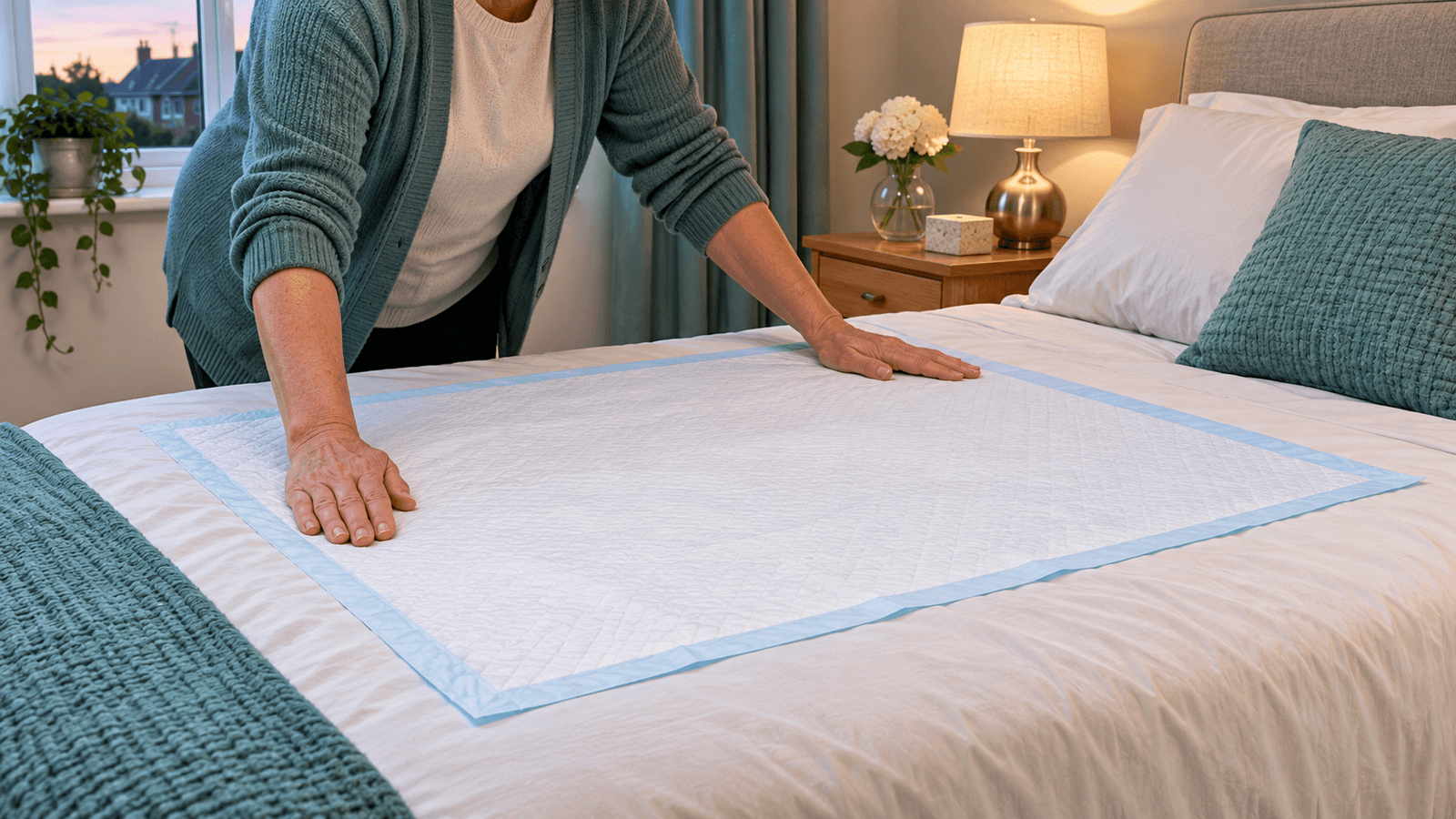
A disposable bed pad can only protect the area it covers. If it
slides, folds or bunches during the night, part of the mattress may be
left exposed and raised edges may feel uncomfortable.
Movement does not always mean the product is faulty. It can be caused
by limited coverage, an incorrect starting position, loose bedding,
frequent turning or the way a person transfers into bed.
This guide explains how to keep disposable
incontinence bed pads flatter and better positioned without using
unsafe pins, tapes or makeshift restraints.
Quick answer: Start with a clean, dry and reasonably
smooth surface. Unfold the pad completely, place the waterproof backing
down and centre the absorbent area beneath the likely leak path. Choose
extra coverage if the person turns frequently, and recheck the pad after
transfers, repositioning or personal care.
Why disposable bed pads
move or fold
Disposable underpads are deliberately lightweight and easy to
replace. That convenience also means they can shift when there is
friction or movement.
Common causes include:
- the pad is too small for the person’s movement pattern;
- it starts too close to the edge of the target area;
- the sheet beneath it is loose, wrinkled or slippery;
- the person turns frequently or sleeps on their side;
- the pad shifts during a transfer into bed;
- a carer repositions the person without checking the pad
afterwards; - excess material is folded beneath the body; or
- multiple pads are stacked and slide against one another.
The Continence
Product Advisor notes that disposable underpads can become folded
and move out of position because they are thin and lightweight. It also
highlights that folds can potentially contribute to skin discomfort.
Position checks are therefore part of using the product, not an optional
extra.
Important: Bed pads protect bedding and furniture.
They do not diagnose or treat incontinence. Seek advice from a GP or
continence professional if symptoms are new, worsening, unexplained or
difficult to manage.
Five steps to keep a bed
pad in place
1. Choose enough coverage
for movement
A pad that only just covers the leak area may move away from it after
one turn. The selected size should include a practical margin around the
target zone.
For focused protection, compare compact 60×40 cm and 56×56 cm
options. For adults who turn more, 60×60 cm or 60×90 cm may provide a
wider protected area. Use the bed pad size guide
to compare the four AvaDry dimensions.
Larger does not automatically mean more absorbent. Choose the
coverage size first, then check absorbency separately.
2. Prepare the bedding
surface
Start with a clean, dry sheet or other suitable surface. Pull loose
bedding reasonably smooth and remove large wrinkles before positioning
the pad.
Do not place a disposable bed pad over:
- electrical cables;
- damaged heated bedding;
- a wet or contaminated surface;
- sharp objects; or
- anything that creates a raised pressure point.
Keep the product and its packaging away from naked flames and strong
heat sources.
3. Place the correct side
down
The soft absorbent surface should face the user. The waterproof
backing should face the bed, sheet or chair.
If the pad is upside down, liquid may not enter the absorbent core
correctly and the surface may feel less stable. If the two sides are not
obvious, check the product instructions before use.
4. Centre, unfold and smooth
Unfold the pad fully without stretching or tearing it. Centre it
beneath the area most likely to need protection, rather than aligning an
edge with that area.
Smooth from the centre towards the edges. Check that:
- there are no trapped folds;
- the corners are not rolled under;
- the pad is not partly hanging over the mattress edge;
- the person will not lie directly on a hard fold; and
- the waterproof backing remains flat against the bedding.
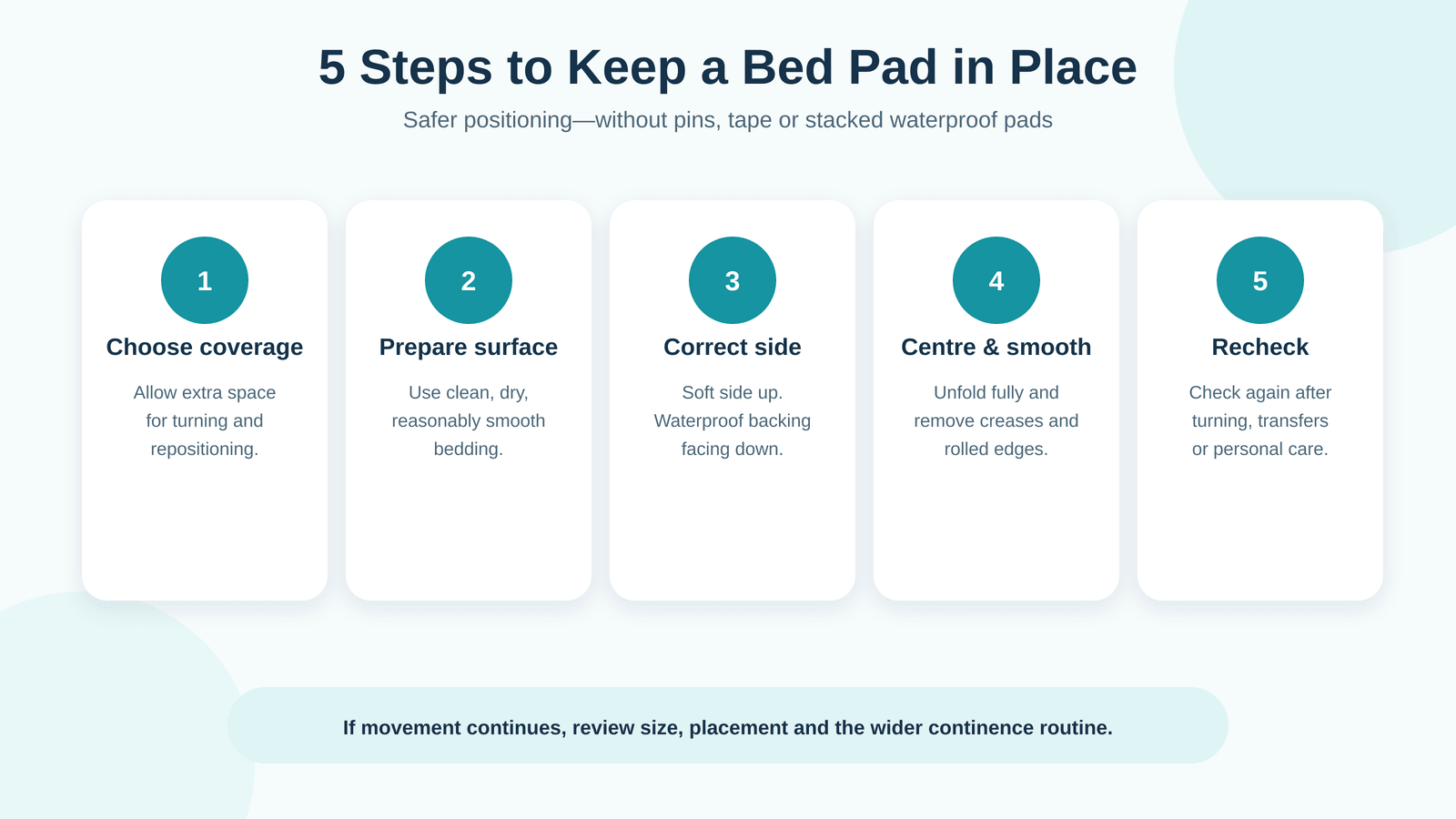
5. Recheck after movement or
care
The pad can shift while a person gets into bed, turns, transfers from
a wheelchair or receives personal care. Recheck it after these movements
instead of assuming the original placement has stayed unchanged.
If care is provided overnight, include a quick position check within
the existing care routine. Protect privacy, explain what you are doing
and involve the person whenever possible.
Match the placement to
sleeping position
Back sleeper
Centre the pad beneath the hips and lower torso, allowing coverage on
both sides. Check that the top and bottom edges extend beyond the likely
leak area.
Side sleeper
Side sleeping can change the direction in which leakage reaches the
bedding. Use enough width around the hips and check whether a wider pad
gives a more reliable margin.
Restless sleeper
For someone who turns frequently, a wider protected zone may be more
useful than a compact pad placed very precisely. Compare 60×60 cm and
60×90 cm sizes, then test which shape stays beneath the target area more
consistently.
Reduced mobility or
assisted transfers
Movement during a transfer can pull the pad away from its starting
position. Check it once the person is comfortably settled. Avoid
dragging the person across the pad, and follow any moving-and-handling
plan provided by a healthcare professional.
What not to use to secure a
bed pad
Avoid improvised methods that can damage the product, bedding or
skin.
Do not:
- attach the pad with safety pins or sharp fasteners;
- tape it to the person’s skin or clothing;
- use strong adhesive directly on delicate bedding;
- tuck a disposable pad so tightly that it tears;
- place heavy objects on the edges; or
- restrain movement simply to keep a pad in position.
If a product includes manufacturer-designed adhesive strips, wings or
another securing feature, use them only as directed. AvaDry product
specifications should be checked for the selected item rather than
assuming every size includes the same feature.
Should
you place a disposable bed pad under the sheet?
Some people use disposable underpads beneath a sheet as additional
mattress backup. This may reduce direct movement, but the sheet can
become wet before the pad absorbs the leak and the setup may not suit
every person.
The main considerations are:
- whether the product instructions allow the intended placement;
- whether the pad can still lie flat;
- whether wet bedding would increase discomfort or laundry;
- whether the person has fragile skin; and
- whether a waterproof mattress protector is already being used.
For direct absorption and easier replacement, disposable bed pads are
often placed on top of the sheet. If you are unsure which arrangement
suits the person’s needs, ask a continence professional.
Do not stack
waterproof-backed pads
Stacking disposable bed pads is not a reliable way to improve
protection. The waterproof backing of the top pad can prevent liquid
passing into the pad underneath. Multiple lightweight layers may also
slide, fold and create an uneven surface.
If one pad does not provide enough protection:
- confirm that it is correctly placed;
- check whether a wider size is needed;
- compare the stated absorbency separately;
- review the fit of any body-worn continence product; and
- seek professional advice if leakage is regular or heavier.
The NHS includes bed protection among the products that may help
manage incontinence, but suitable products and combinations depend on
individual needs.
When a larger pad may help
A larger pad may be useful when:
- the person repeatedly moves beyond the protected area;
- leakage reaches the bedding beside a compact pad;
- the care routine involves frequent repositioning; or
- the pad remains flat but the coverage is simply too narrow.
A larger pad may not solve the problem when:
- it is being placed in the wrong location;
- the sheet beneath it is heavily wrinkled;
- it is folded to fit the bed;
- the body-worn product is leaking because of fit or capacity; or
- the pad is being used as the sole protection for needs beyond its
intended role.
For full product-selection guidance, read Disposable
Bed Pads for Adults: Sizes, Uses and How to Choose.
A practical bedtime
placement checklist
Before the person settles for the night, confirm:
- the bedding surface is clean and dry;
- the selected pad provides enough coverage;
- the absorbent side faces upwards;
- the waterproof backing faces down;
- the pad is centred beneath the likely leak path;
- all folds and rolled edges have been removed;
- any body-worn product is correctly fitted;
- a replacement pad and clean bedding are accessible; and
- the pad will be rechecked after movement or care.
This checklist should support the person’s comfort and dignity, not
make the routine unnecessarily clinical.
If the bed pad still moves
Use the pattern of movement to diagnose the problem.
| What you notice | Likely issue to review | Practical next step |
|---|---|---|
| Pad slides sideways | Turning or insufficient width | Re-centre and compare wider coverage |
| Corners roll underneath | Incomplete unfolding or excess material | Smooth from centre to edges; review size |
| Pad shifts during transfer | Placement checked too early | Recheck after the person is settled |
| Leakage reaches outside the pad | Coverage or starting position | Measure the target area and add a margin |
| Pad stays flat but leaks through/over | Absorbency or wider routine | Review absorbency and body-worn product |
| Skin becomes red or sore | Moisture, friction, folds or another cause | Remove folds and seek professional advice |
Persistent problems should prompt a review of the complete continence
routine rather than repeated improvised fixes.
Frequently asked questions
How do I stop a
disposable bed pad sliding?
Place it on a clean, dry and smooth surface, use enough coverage for
movement, centre it beneath the target area and recheck after transfers
or turning. Do not use pins or unsafe adhesive methods.
Why does my bed pad bunch
up at night?
Common reasons include limited coverage, loose bedding, frequent
movement, an incorrect starting position or excess material that was not
fully smoothed.
Can I tape a bed pad to the
sheet?
Do not use improvised strong adhesive. It may damage bedding or
create raised edges. Only use securing features supplied by the
manufacturer and follow the product instructions.
Is a larger bed pad
less likely to move?
Extra coverage can help a restless sleeper remain over the protected
area, but a larger pad can still fold if it is positioned poorly. Size,
shape and placement all matter.
Can I use two disposable
pads together?
Stacking waterproof-backed pads is not recommended as a general
solution. The top backing may block liquid from reaching the lower pad
and the layers can shift against one another.
When should I ask for
professional advice?
Seek advice if leakage is new or worsening, regularly bypasses the
current products, causes skin problems, or the care routine is becoming
difficult to manage.
Improve overnight bed
protection
Reliable placement starts with the right coverage, a smooth surface
and regular position checks. Avoid unsafe fasteners and stacked pads. If
movement or leakage continues, review the product size, absorbency and
wider continence routine.
Compare
AvaDry disposable bed pads in four coverage sizes, or use the bed
pad buying guide to compare size, absorbency, backing and
comfort.