

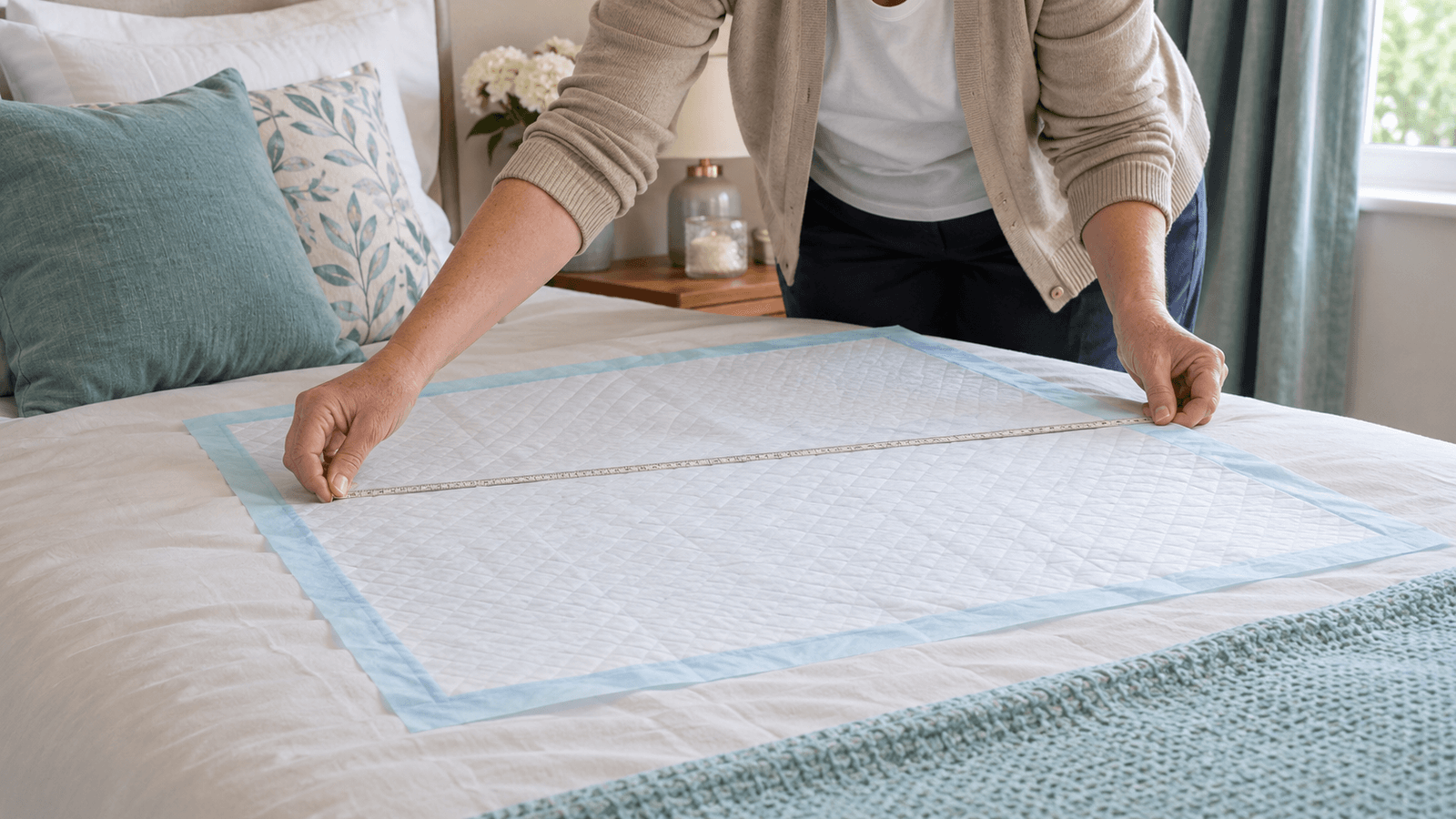
Choosing the right bed pad size is mainly a question of coverage. The
pad needs to sit beneath the area most likely to be affected, with
enough extra space to allow for sleeping position, turning and care
tasks.
The largest option is not automatically the best for every person. A
compact pad can be easier to place for a focused area, while a wider pad
may be more practical for someone who changes position frequently. Size
also does not tell you how absorbent a pad is, so coverage and
absorbency should always be checked separately.
This bed pad size guide compares the four AvaDry
disposable bed pad sizes and explains how to select a practical
starting point for an adult, older person, care task or travel
routine.
Quick answer: Measure the target area, observe where
leakage usually reaches the surface and allow extra coverage for
movement. Use 60×40 cm or 56×56 cm for focused protection, 60×60 cm for
a broader square area, and 60×90 cm when wider rectangular coverage is
needed. Trial a manageable pack before ordering in bulk.
Why bed pad size matters
A bed pad only protects the surface it covers. If it is too small for
the likely leakage area, moisture may reach the sheet or mattress around
the edges. If it is much larger than necessary, excess material may be
harder to position and can fold or bunch.
The right coverage can help:
- protect the area most likely to be affected;
- reduce unnecessary bedding changes after a leak;
- make placement quicker and more consistent;
- support a simpler care routine; and
- reduce the chance of an edge sitting directly beneath a pressure
point.
Disposable underpads are lightweight, so placement still matters
after choosing a size. Independent guidance from the Continence
Product Advisor notes that disposable underpads can move or fold out
of position. Keep the pad flat and recheck it after the person turns or
is repositioned.
Important: A bed pad protects bedding or furniture;
it does not treat the cause of bladder or bowel symptoms. New, worsening
or unexplained symptoms should be discussed with a GP or continence
professional.
AvaDry bed pad sizes at a
glance
| AvaDry size | Shape and coverage | Practical starting point | Product |
|---|---|---|---|
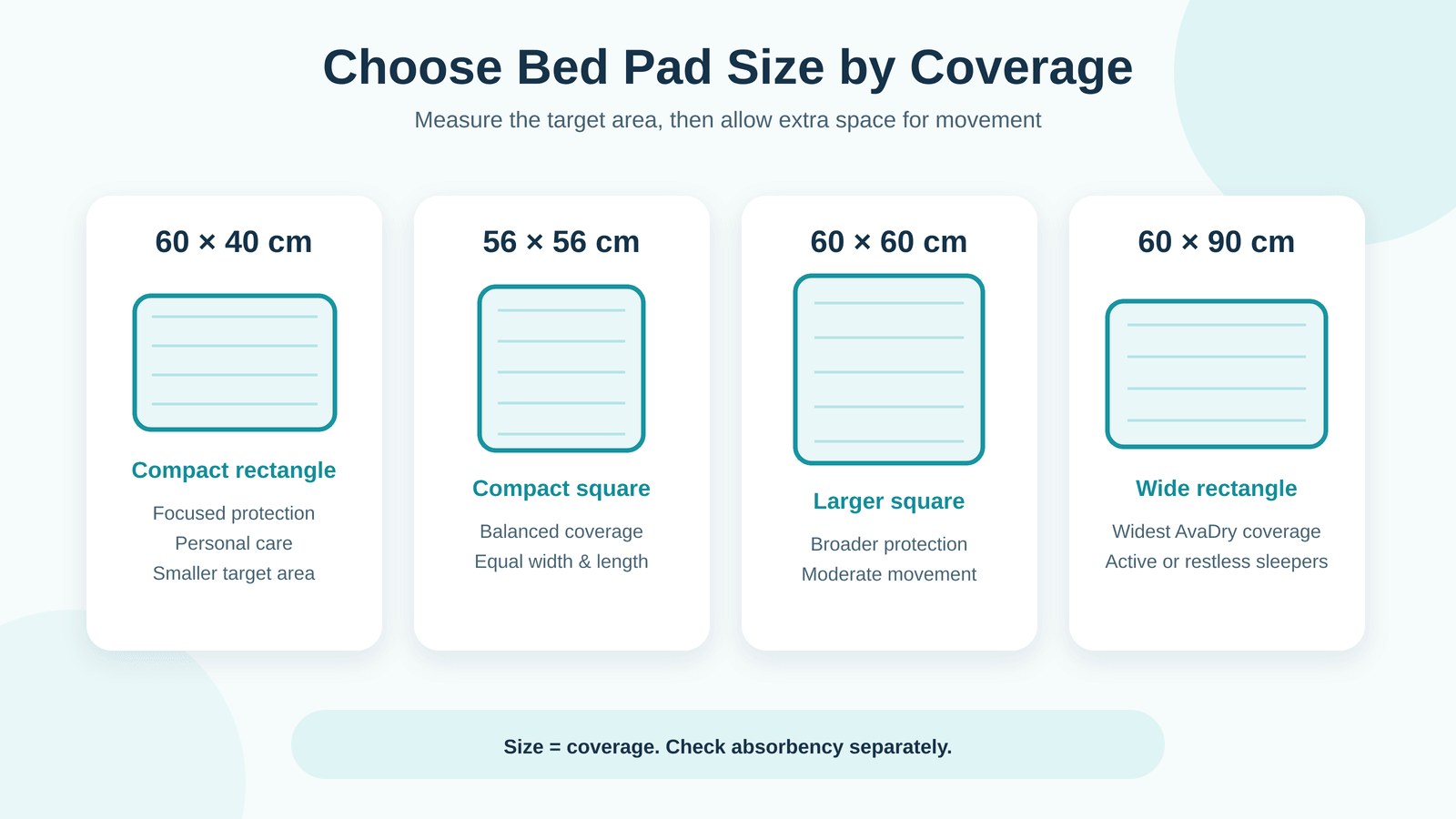
| 60 × 40 cm | Compact rectangle | Focused protection, personal care or a smaller target area | View 60 × 40 cm bed pads |
| 56 × 56 cm | Compact square | A balanced compact area where equal width and length are useful | View 56 × 56 cm bed pads |
| 60 × 60 cm | Larger square | Broader coverage for someone who changes position | View 60 × 60 cm bed pads |
| 60 × 90 cm | Wide rectangle | The widest AvaDry coverage for active or restless sleepers | View 60 × 90 cm bed pads |
These dimensions describe the total pad area. They should not be
treated as an absorbency rating. Materials, construction and the amount
and distribution of the absorbent core also influence performance.
How to measure for a bed pad
You do not need to cover the whole mattress. The aim is to protect
the zone where leakage is most likely to reach the bed.
Step 1: Identify the target
area
Observe the person’s usual sleeping or resting position. For many
adults, the target area is around the hips and lower torso. During
personal care, the target may be a smaller, clearly defined area.
Step 2: Measure width and
length
Use a tape measure across the part of the bed, chair or suitable
surface that needs protection. Record both dimensions rather than
estimating by eye.
Step 3: Allow for movement
Someone who stays mainly in one position may need less coverage than
someone who turns, slides down the bed or requires assisted
repositioning. Add a practical margin around the target area instead of
positioning the pad exactly at its edge.
Step 4: Check the bed
pad will lie flat
The selected pad should fit the usable surface without being forced
against a bed rail, cable, heated item or raised edge. Unfold it
completely and smooth out creases before use.
Step 5: Trial before
buying a large pack
Test the size during the normal routine. Check whether it remains
beneath the target area, whether the edges fold and whether the
surrounding bedding stays protected. If the coverage works, you can then
choose a pack quantity with more confidence.
When to choose a 60 × 40 cm
bed pad
A 60×40 cm pad provides compact rectangular coverage. It can be a
practical starting point when protection is needed for a focused area
rather than a broad section of the bed.
Consider it for:
- personal care or product changes;
- a smaller, predictable target area;
- short-term surface protection;
- travel, where compact storage matters; or
- users who remain mainly in one position.
Because coverage is compact, placement should be checked carefully.
If leakage regularly reaches beyond the edges or the person moves
frequently, compare a larger option.
When to choose a 56 × 56 cm
bed pad
A 56×56 cm pad gives compact square coverage. Equal width and length
can make it useful when the protected area is not strongly
rectangular.
It may suit:
- a concentrated bed or chair area;
- routine care tasks;
- an adult who needs balanced compact coverage; or
- a household testing disposable bed protection for the first
time.
The difference between 56×56 cm and 60×40 cm is not simply “larger”
or “smaller.” Their shapes distribute coverage differently. Choose
according to the target area.
When to choose a 60 × 60 cm
bed pad
A 60×60 cm pad provides broader square coverage. It can be a useful
middle option when compact sizes feel too limited but the widest
rectangular pad is unnecessary.
Consider 60×60 cm when:
- the person changes position moderately;
- extra coverage is helpful in more than one direction;
- the pad is used as backup beneath a body-worn product; or
- the care routine needs a larger flat working area.
Recheck the pad after transfers or repositioning. A larger surface
area helps only if the pad stays beneath the likely leak path.
When to choose a 60 × 90 cm
bed pad
A 60×90 cm pad offers the widest coverage in the AvaDry disposable
range. It can be a practical starting point for adults who move more in
bed or when a wider rectangular area needs protection.
Consider it for:
- active or restless sleepers;
- wider overnight backup protection;
- assisted care where repositioning is common; or
- situations where smaller pads have left surrounding bedding
exposed.
Do not assume the widest pad can replace a suitable body-worn
continence product for regular or heavier leakage. The NHS lists bed
protection as one part of incontinence management, while product choice
may require individual assessment. For persistent leaks, review the
whole routine with a healthcare or continence professional.
Match size to the situation
| Situation | Coverage priority | Suggested comparison |
|---|---|---|
| Focused care task | Compact, easy-to-place protection | 60×40 cm vs 56×56 cm |
| Adult who stays mainly in one position | Coverage beneath the usual leak path | Start compact, then review |
| Adult who turns during sleep | Extra coverage in several directions | 60×60 cm vs 60×90 cm |
| Restless sleeper | Wider protected zone | 60×90 cm |
| Travel or respite stay | Proven size plus easy packing | Take the size already tested at home |
| Reduced mobility or assisted transfers | Flat placement and frequent position checks | Choose enough coverage without folds |
This table provides a starting point, not a clinical prescription.
The best size is the one that works consistently in the person’s real
routine.
Size and absorbency are
different
One of the most common buying mistakes is treating dimensions as an
absorbency score. A 60×90 cm pad covers more area than a 60×40 cm pad,
but that does not by itself prove that it will hold more liquid.
When comparing bed pads, check:
- the coverage dimensions;
- the stated absorbency or intended protection level;
- the construction of the absorbent core;
- how quickly moisture moves away from the surface;
- whether the waterproof backing remains intact; and
- how the product performs during the normal care routine.
If a pad leaks, first check whether it moved, folded or missed the
affected area. A positioning problem can look like an absorbency
problem.
For a broader product comparison, read the guide
to buying bed pads for incontinence.
How to place the chosen
size correctly
- Start with a clean, dry surface.
- Unfold the pad fully.
- Place the soft absorbent side facing upwards.
- Put the waterproof backing against the sheet, mattress or
chair. - Centre the pad beneath the target area.
- Smooth out every crease and raised edge.
- Recheck the position after the person moves or receives care.
- Replace the pad when wet, soiled or damaged, following the product
instructions.
Avoid stacking waterproof-backed disposable pads. The backing of the
upper pad can prevent liquid reaching the pad below, while additional
layers may create uncomfortable folds.
Common bed pad sizing
mistakes
- Covering the whole mattress unnecessarily: Protect
the likely leak zone rather than buying by mattress size alone. - Choosing the largest option without testing: More
material can fold if it is not positioned well. - Assuming a larger pad is more absorbent: Compare
absorbency separately. - Ignoring sleeping position: Side sleepers and
people who turn may need a wider protected area. - Placing the edge beneath the body: Centre the pad
so the target area is not sitting on an edge. - Not rechecking after movement: Transfers and
repositioning can shift a lightweight underpad. - Buying in bulk too early: Confirm size and comfort
before committing to a large quantity.
Frequently asked questions
What is the best bed
pad size for an adult?
There is no single best size for every adult. Compact 60×40 cm and
56×56 cm pads suit focused protection, 60×60 cm gives broader square
coverage, and 60×90 cm offers the widest AvaDry coverage. Choose
according to the target area and movement.
Is a 60 × 90 cm
bed pad better than 60 × 60 cm?
It provides wider rectangular coverage, but it is not automatically
better. A 60×60 cm pad may fit a square target area more efficiently.
Compare the shape needed, how much the person moves and absorbency as a
separate feature.
Should a bed pad
cover the whole mattress?
Usually not. Position it beneath the area most likely to be affected.
A waterproof mattress protector may provide additional backup for the
wider mattress, depending on the person’s needs.
Do bigger bed pads absorb
more?
Not necessarily. Size describes surface coverage. Absorbency depends
on the materials and construction, so check the product information
separately.
Can the same size be used
on a chair?
Some disposable underpads can protect suitable chairs, but a
bed-sized pad may be larger than the chair surface. Keep it flat,
prevent folds and make sure it does not create a slipping or transfer
hazard.
Which size should I buy
first?
Measure the target area and choose the smallest size that provides a
sensible movement margin. Buy a manageable pack first, then review
coverage before ordering more.
Choose your AvaDry bed pad
size
The right size should cover the likely leak area, allow for movement
and remain flat during use. Start with measurement rather than
guesswork, check absorbency separately and test the selected size in the
normal routine.
Compare
AvaDry disposable bed pads in 60×40, 56×56, 60×60 and 60×90 cm
sizes, or return to the main bed
pad buying guide for absorbency, backing and
disposable-versus-washable guidance.