

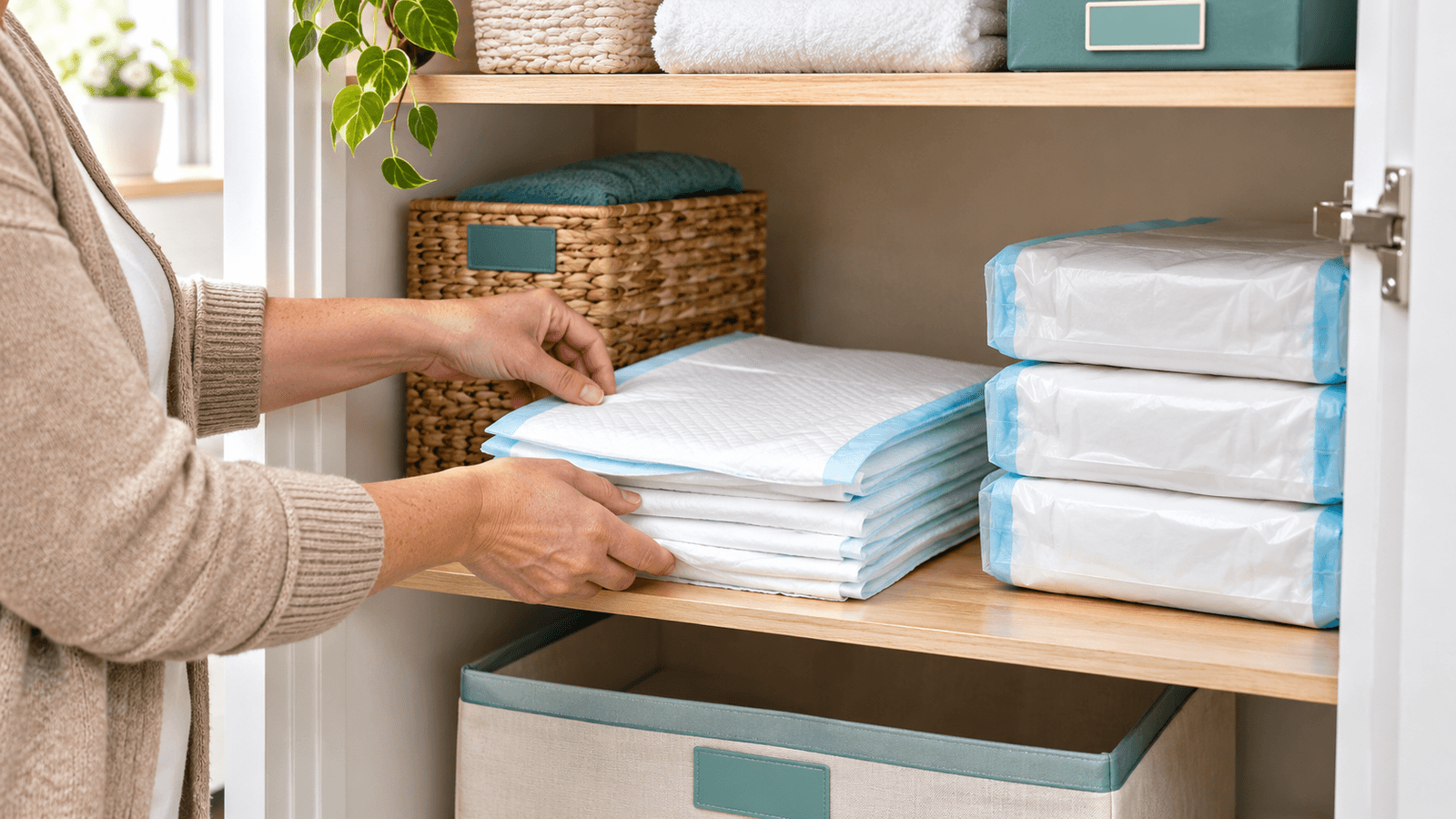
Buying too few disposable bed pads can leave a household short before
the next delivery. Buying a very large pack before confirming the right
size can leave you with unsuitable stock.
A simple usage estimate helps balance both risks. Start with the
number of pads actually used during a typical day or night, calculate
the likely weekly or monthly total, then keep a reasonable reserve for
unexpected changes, travel or delivery delays.
This guide gives a practical planning method for AvaDry
disposable bed pads. It is a stock-planning tool, not a medical
recommendation or fixed changing schedule.
Quick answer: Average daily use × number of days =
estimated quantity. One pad each night is about 7 per week or 30 per
month. Two pads per day is about 14 per week or 60 per month. Add a
small reserve only after confirming the size and routine work for the
person.
There is no fixed
number for every person
Bed pad use varies because a disposable underpad may be used:
- once each night as backup beneath a body-worn product;
- only on occasional nights;
- during personal care or product changes;
- on a bed and a suitable chair;
- more than once when wet or soiled; or
- temporarily during travel, illness or respite care.
The right quantity depends on the individual’s care routine, not a
universal rule. A pad should be checked and replaced when wet, soiled or
damaged, following the product instructions and any professional care
plan.
If leakage is regular or heavier, do not try to reduce usage by
leaving a wet pad in place. The NHS
advises that product choice may involve assessment by a healthcare
professional, and new or worsening symptoms should be discussed with a
GP or continence service.
A simple bed pad usage
formula
Use this planning formula:
Average pads used per day × number of days = base
quantity
Then consider a modest practical reserve for:
- an occasional extra change;
- travel or overnight stays;
- delivery delays;
- a visiting carer or respite routine; and
- a pack being opened in more than one room.
This reserve is for stock management. It should not be used to set or
delay care. Actual changing should follow the condition of the pad and
the person’s needs.
Example
If a person normally uses one disposable bed pad each night:
- 1 × 7 days = 7 pads per week;
- 1 × 30 days = about 30 pads per month.
If an extra pad is sometimes needed, a 50-pack may offer a more
practical ordering interval than buying exactly 30.
Weekly and monthly quantity
planner
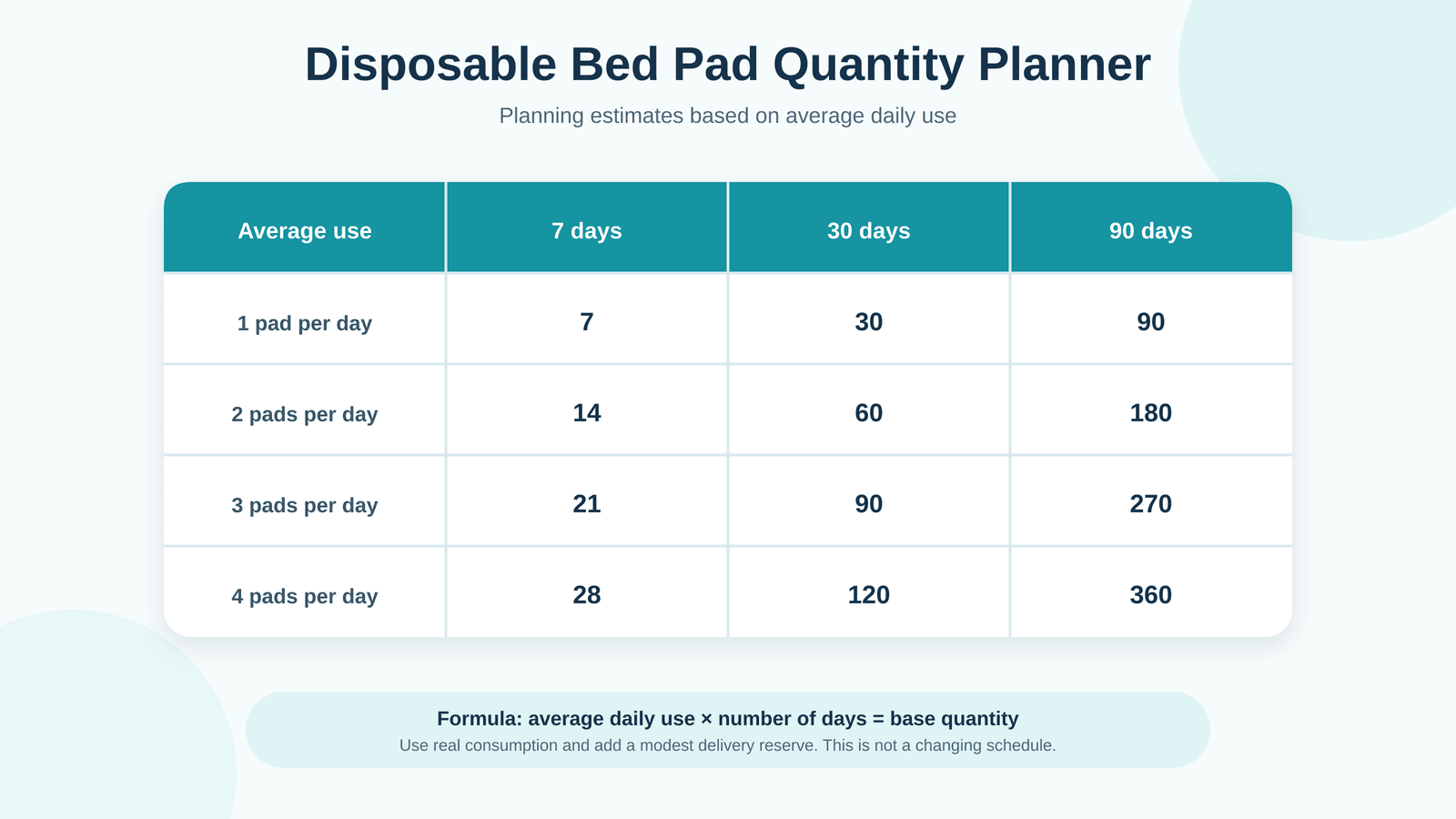
| Average use | 7 days | 30 days | 90 days |
|---|---|---|---|
| 1 pad per day | 7 | 30 | 90 |
| 2 pads per day | 14 | 60 | 180 |
| 3 pads per day | 21 | 90 | 270 |
| 4 pads per day | 28 | 120 | 360 |
These figures are simple multiplication, not a recommended change
frequency. Some people use fewer pads because protection is occasional;
others need additional changes because the pad becomes wet, soiled or
displaced.
Track real use before
choosing a pack
If the routine is new, record actual usage for seven days.
Use a simple note with:
- date;
- pad size;
- where it was used;
- whether it was used overnight or for care;
- number of replacements; and
- reason for an extra change, if relevant.
Do not record unnecessary personal details. The goal is to identify a
reliable average, not to create a clinical record.
At the end of the week:
- add the total pads used;
- divide by seven for the daily average;
- multiply by the number of days until the next planned order;
and - add a reasonable reserve.
If the weekly total changes sharply, identify why before placing a
large order. A different leakage pattern, illness, a poorly fitting
body-worn product or a pad placement problem may be increasing
usage.
Choose the size before the
quantity
Pack planning should come after size selection. A low unit price is
not good value if the pad does not cover the required area.
AvaDry disposable bed pads are available in:
- 60×40 cm for compact rectangular coverage;
- 56×56 cm for compact square coverage;
- 60×60 cm for broader square coverage; and
- 60×90 cm for the widest AvaDry coverage.
Use the bed pad
size guide to compare situations and shapes. Trial a manageable
quantity during the normal care routine before buying 100, 200 or
more.
Remember that dimensions describe coverage, not absorbency. A larger
pad does not automatically provide a higher absorbency level.
How AvaDry
pack quantities fit different routines
AvaDry product pages offer multiple sheet quantities, including 25,
50, 100, 200 and larger bulk options on selected products. Availability
and price should always be checked on the current product page.
25 pads
A 25-pack can be useful when:
- testing a new size;
- use is occasional;
- storage space is limited;
- the household wants a short trial before bulk buying; or
- pads are mainly kept for travel or backup.
At one pad per day, 25 pads cover about three and a half weeks before
any reserve.
50 pads
A 50-pack may suit:
- one-pad-per-day use with extra stock;
- two-pad-per-day use for about 25 days;
- a proven size used at home and during travel; or
- households that prefer a moderate ordering interval.
100 pads
A 100-pack may be practical once the correct size and routine are
established.
At typical calculated use:
- 1 per day is about 100 days;
- 2 per day is about 50 days;
- 3 per day is about 33 days; and
- 4 per day is about 25 days.
These are planning estimates. Replace pads according to actual
condition and care needs.
200 or more pads
Bulk quantities may suit regular, predictable use when:
- the size has already been tested;
- there is clean, dry storage;
- several care areas need stock;
- delivery frequency is limited; or
- a care setting has documented consumption.
Before ordering a large quantity, confirm current product
availability, pack configuration and storage capacity.
Plan for more than one
location
Some households keep bed pads in several places:
- beside the bed;
- in a bathroom or care area;
- near a suitable chair;
- in a travel or emergency bag; and
- with a family member or respite provider.
Count all opened storage points when checking stock. Otherwise, the
household may reorder unnecessarily while usable packs remain
elsewhere.
Keep a small working supply accessible and store the remaining
unopened packs in one dry location. This makes stock checks easier.
Safe storage for
disposable bed pads
Store unopened and unused pads:
- in a clean, dry cupboard or shelving area;
- away from moisture and strong heat;
- away from naked flames;
- clear of household chemicals;
- inside their original packaging where possible; and
- where the pack size and product dimensions can be read easily.
Use older suitable stock before newly delivered packs so long as the
packaging remains intact and the product is still appropriate.
Do not store so many packs that they block access, create a trip
hazard or become difficult for the person or carer to handle.
When usage is higher than
expected
An increase in bed pad use may be caused by:
- more frequent leakage;
- the pad moving away from the target area;
- using too small a coverage size;
- a body-worn product leaking because of fit or absorbency;
- repeated care tasks;
- pads being changed early for convenience rather than need; or
- a temporary change in health or routine.
Do not respond by simply stacking disposable pads. Waterproof backing
can prevent the lower pad absorbing liquid, and extra layers may move or
fold.
If the pad shifts, read How
to Keep Disposable Bed Pads in Place at Night. If symptoms or
leakage are changing, seek advice from a GP or continence
professional.
When usage is lower than
expected
Lower use may mean the pad is needed only occasionally, or that a
body-worn product is containing leakage effectively. It can also mean
the household ordered more than the routine requires.
Before the next order:
- count unopened packs;
- check stock in every care area;
- recalculate the daily average;
- reduce the order interval or quantity if appropriate; and
- avoid switching size simply to use excess stock.
Unused pads should remain clean, dry and in suitable packaging. A
disposable pad that has already been used, contaminated or damaged
should not be returned to stock.
A simple reorder point
A practical reorder point is:
average daily use × expected delivery time, plus a small
reserve
For example, if use averages two pads per day and delivery normally
takes five days:
- 2 × 5 = 10 pads for the delivery period;
- reorder before stock falls to that level, allowing a reasonable
buffer.
Check current delivery information rather than assuming the same lead
time for every order.
Common quantity-planning
mistakes
- Buying bulk before confirming size: Test coverage
first. - Using a fixed number without tracking: Base orders
on real use. - Treating a wet pad as stock to conserve: Replace
according to need. - Forgetting pads stored in another room: Count every
location. - Ignoring delivery time: Reorder before the final
few pads. - Confusing size with absorbency: Compare both
separately. - Stacking pads to use stock faster: This can reduce
effective protection. - Ordering without dry storage: Confirm space before
buying large quantities.
Frequently asked questions
How many
disposable bed pads do I need for one month?
One per day is about 30 pads for a 30-day month. Two per day is about
60, three is about 90 and four is about 120. Add a practical reserve
after tracking real use.
How many bed pads are
in a weekly supply?
At one per day, a weekly supply is 7. At two per day it is 14. Actual
use may be higher or lower depending on care needs and whether pads
become wet or soiled.
Should I buy 25, 50 or 100
pads?
Choose 25 when testing a size or using pads occasionally. Consider 50
or 100 after the size and average usage are established. Check current
product options before ordering.
Can
I use one disposable bed pad for several nights if it stays dry?
Follow the manufacturer’s instructions. Replace the pad if it is wet,
soiled, damaged or contaminated. Do not reuse a disposable pad after it
has served its intended single-use purpose.
Is it cheaper to buy bed
pads in bulk?
A larger pack may reduce the unit price, but it only represents value
when the size suits the person, the pads will be used and suitable
storage is available.
How much reserve stock
should I keep?
Keep enough to cover normal delivery time plus a small allowance for
unexpected extra changes or delays. Avoid an excessive reserve until the
routine is stable.
Plan the next bed pad order
Start with one week of real usage, confirm the correct size and
calculate the quantity needed until the next delivery. Buy a manageable
pack when the routine is new, then move to larger quantities only when
coverage and consumption are predictable.
Compare
AvaDry disposable bed pads and pack options, or return to the bed
pad buying guide for help with size, absorbency, backing and product
type.